What Is an EMC Enclosure? nVent HOFFMAN Guide
1. What Is EMC?
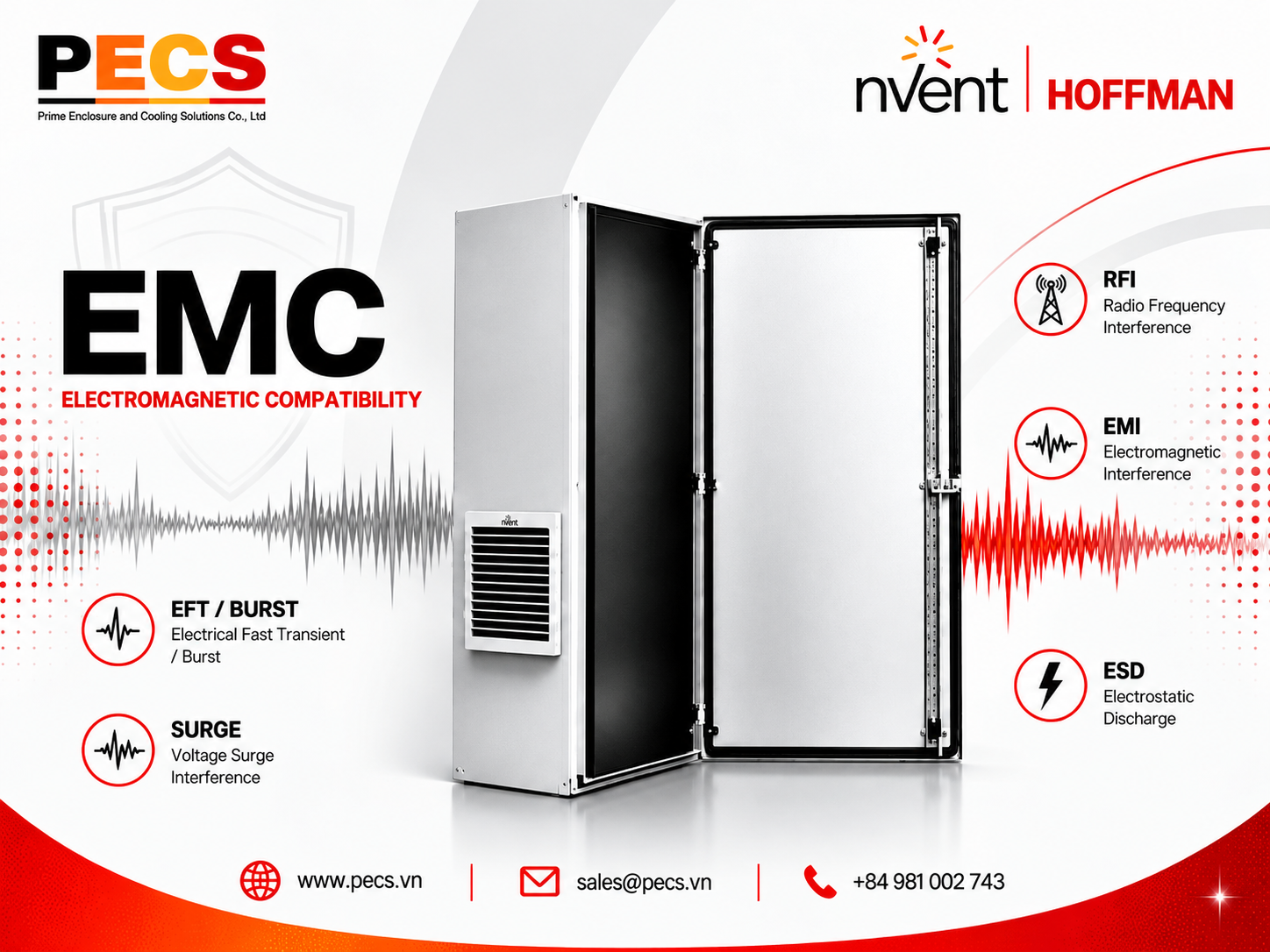
EMC – Electromagnetic Compatibility is the ability of electrical and electronic equipment to operate properly in its electromagnetic environment without causing unacceptable interference to other equipment.
An EMC enclosure is designed to reduce electromagnetic interference (EMI/RFI) generated by equipment inside the enclosure while also protecting internal equipment from external electromagnetic interference. EMC enclosures are particularly suitable for systems using VFDs, servo drives, PLCs, industrial Ethernet, switching power supplies, instrumentation, and other sensitive electronic equipment.
2. Standard Enclosure vs. EMC Enclosure
A conventional metal enclosure may provide a certain level of electromagnetic shielding. However, a metal enclosure does not automatically provide EMC protection. An EMC enclosure is designed as a complete shielding system, including: Enclosure body and door, EMC/RFI gasket, Bonding and grounding, Conductive contact surfaces, Cable entry and gland plates, Joints and accessories
Even small gaps around doors, joints, or cable entries can become paths for electromagnetic interference. Therefore, effective EMC performance depends on the complete enclosure design, sealing, bonding, grounding, and installation method.
3. How Is an EMC Enclosure Constructed?
3.1. Enclosure Body
The enclosure body creates the main electromagnetic shielding barrier around the equipment. nVent HOFFMAN offers EMC enclosure solutions using mild steel, stainless steel, and polycarbonate with conductive EMC coatings.
3.2. EMC/RFI Gasket
The gasket is one of the most important differences between a standard enclosure and an EMC enclosure. It provides environmental sealing while also helping maintain electromagnetic shielding around doors and contact areas. Depending on the product family, nVent HOFFMAN uses solutions such as stainless-steel spring-finger gaskets and woven steel-mesh gaskets.
3.3. Bonding & Grounding
The door, enclosure body, and other conductive components need to maintain proper electrical continuity. Grounding studs, bonding points, and conductive contact areas help maintain the integrity of the shielding system.
3.4. Conductive Contact Surfaces
Specific contact areas may use plated surfaces to maintain electrical continuity and reduce the impact of paint layers between metal components.
3.5. Cable Entry
Cable entry is one of the most critical points in EMC design. A proper installation should consider the complete system: EMC enclosure + EMC cable entry + bonding/grounding + cable shielding
4. Where Are EMC Enclosures Used?
EMC enclosures are suitable for applications where electromagnetic interference can affect equipment reliability, signal integrity, or measurement accuracy.
Automation & Machine Building: Typical applications include: PLCs and HMIs, Servo drives, VFDs/Inverters, Motion control systems, Industrial PCs, I/O systems, Machine control systems,
Industrial Control: Process control and automation systems containing multiple electronic, switching, and drive components may require effective EMI/RFI control.
Data & Communication: Typical applications include: Industrial Ethernet, Network equipment, Communication systems, Data acquisition systems
Measurement & Instrumentation: Measurement and instrumentation systems using low-level signals can be particularly sensitive to electromagnetic noise.
Power Electronics: Typical applications include: Variable Frequency Drives, Servo Drives, UPS systems, Switching Power Supplies. Power Converters
Transportation: EMC solutions may be used in: Railway systems, Electric vehicles, EV charging infrastructure, Other transportation and electrical systems where EMI/RFI control is required
5. nVent HOFFMAN EMC Enclosure Product Families
nVent HOFFMAN offers a range of EMC enclosure solutions, from compact enclosures to large modular systems.
5.1. Concept EMC: Concept EMC is a mild-steel wall-mounted enclosure designed for industrial control and automation applications. Key features: Mild steel construction, EMC/RFI gasket, Grounding provision, Continuously welded seams, NEMA Type 4, 12, 13/IP66. Typical applications: Industrial control, automation, and machine control.
5.2. InLine EMC: InLine EMC is a compact enclosure family available in screw-cover and hinged-door configurations. Key features: EMC/RFI gasket, Bonding provisions, Plated contact areas, Shielding effectiveness of >50 dB at 1 GHz for applicable designs, NEMA Type 1 / IP40. It is suitable for compact control and electronic equipment requiring EMI/RFI shielding.
5.3. Continuous Hinge with Clamps EMC: This enclosure family combines continuous hinge + clamps + EMC gasket. Selected mild-steel models are specified by nVent HOFFMAN with shielding effectiveness of >80 dB at 1 GHz. Typical applications include: Industrial control, Factory automation, Machine building, Electronic equipment
5.4. Stainless Steel EMC: Stainless Steel EMC enclosures are designed for applications requiring higher corrosion resistance and robust environmental protection. Selected product families are rated NEMA Type 4, 4X, 12, 13 – IP66. Typical applications include: Food & Beverage, Chemical, Pharmaceutical, Outdoor applications, Corrosive environments
5.5. Wallmount Hinged with Clamps EMC: This product family provides larger wall-mounted EMC enclosure solutions, including stainless-steel versions. For example, the A242408LPEMCSS uses stainless steel 304 construction and an EMC gasket system. These enclosures are suitable for larger industrial control and automation applications requiring EMI/RFI shielding.
5.6. QLine D / QLine E EMC: EMC protection is not limited to metal enclosures. QLine D EMC and QLine E EMC use polycarbonate construction combined with a conductive EMC coating. Key features: Impact-resistant polycarbonate, Conductive EMC coating, EMC gasket, IP66/NEMA Type 4, 4X, 12, 13. These products are suitable when the application requires: EMC protection + corrosion resistance + non-metallic enclosure construction
5.7. ProLine EMC: For larger modular control systems, nVent HOFFMAN provides EMI/RFI doors, covers, sides, tops, bases, and accessories for the ProLine platform. This allows engineers to build large modular control enclosures while maintaining an EMI/RFI shielding approach.
6. Standard Enclosure vs. EMC Enclosure
|
Feature |
Standard Enclosure |
EMC Enclosure |
|---|---|---|
|
Mechanical protection |
Yes |
Yes |
|
IP/NEMA protection |
Depends on model |
Depends on model |
|
EMI/RFI shielding |
Not the primary objective |
Primary objective |
|
EMC gasket |
Normally not |
Yes |
|
Bonding |
May be provided |
Specifically considered |
|
Conductive contact |
Not always required |
Important |
|
EMC cable entry |
Application dependent |
Important |
|
Typical application |
General control panels |
EMI-sensitive or EMI-generating systems |
7. EMC Is More Than Just the Enclosure
An EMC enclosure does not automatically guarantee that the complete system will be EMC compliant. Overall EMC performance also depends on:
Enclosure + Gasket + Bonding + Grounding + Cable Entry + Cable Shielding + Filters + Equipment Layout + Installation
Therefore, EMC should be considered from the early design stage of the electrical system, rather than being treated as a final-stage modification. A properly designed EMC enclosure should work together with appropriate cable shielding, grounding, bonding, filtering, and installation practices to achieve the desired system-level EMC performance.
8. Conclusion
An EMC enclosure is more than a conventional metal cabinet. It is a solution designed to: Contain EMI/RFI generated inside the enclosure and Shield sensitive equipment from external EMI/RFI.
With product families including InLine EMC, Concept EMC, Continuous Hinge EMC, Stainless Steel EMC, Wallmount EMC, QLine D/E EMC, and ProLine EMC solutions, nVent HOFFMAN provides EMC enclosure solutions ranging from small junction boxes to large modular control systems.
For applications using VFDs, servo drives, PLCs, industrial Ethernet, power electronics, and sensitive instrumentation, EMC enclosure design should be considered an integral part of the overall system design, rather than simply a choice of enclosure.